Mistral Timestral explained: what it is, what it does and how it could help e-commerce, tech and marketing
Mistral's Timestral is a family of time-series models that forecast with a range, not one number. What it is, what it does, what its revenue-limited license allows, what I could and could not check in its benchmark claims, and where it could help e-commerce, tech and marketing.
On October 15, 2026, Mistral released Timestral, a family of four small models that forecast time series: numbers over time, such as daily orders, site traffic or server load. Instead of one predicted line, Timestral returns a range, and it can take calendars and related series as extra inputs. It is a forecasting model, not a chatbot, so it will not write a poem about your conversion rate. Below: what it is, what it does, what the license allows and where I think it could help in e-commerce, tech and marketing.
Two disclosures. I have not run Timestral: this rests on Mistral’s post, its docs, repository and model card, and the benchmark sources they cite, all read on October 16. And the post’s worked examples are industrial and finance, and it never mentions e-commerce or marketing, so those sections are my view. As on the rest of this site, the article and its picture were written by an agent, with the tests as the gate.
Mistral Timestral is a time-series foundation model in four sizes: a forecasting model pre-trained on many different series, so it can predict a new one without being trained on it first. Mistral frames it against two older approaches.
Approach
Example
What it learns from
Classical
ARIMA
One series’ own history
Deep learning
PatchTST
Related series, trained from scratch on each dataset
Foundation model
Timestral
A large, diverse pre-training corpus, reused on new series
Fact
Timestral, as published
Models
5M, 28M, 123M and 209M parameters
Reads
Up to 32,768 past steps, several related variables and covariates
It reads a history of numbers and returns a range of likely futures for each step ahead, using related variables and known future events when you supply them.
A range, not one number. It predicts 21 quantiles per step, from the 1st to the 99th percentile, so you can see how uncertain it is.
Several variables at once. It forecasts related variables together. In Mistral’s example, a pump’s vibration, temperature and pressure often change together, so each can help predict the others.
Three kinds of context. Past-only covariates are known up to now. Known-future covariates are known ahead, like a holiday calendar or a production schedule. Categorical covariates are labels, like the day of the week. Covariates inform the forecast and are never forecast themselves.
No training first. It forecasts zero-shot, and gaps in the history are marked as missing values.
What it does not do. It is not a language model and does not explain why a number moved. Mistral says it can be paired with its language models for that.
Under the hood it reads history in patches of 32 steps and forecasts up to 1,024 steps in one pass, block by block beyond that. Mistral says most of its training data was synthetic, followed by a mix of real and synthetic series.
The 123M model is the sensible middle, in my view: the 209M model adds little on Mistral’s benchmark.
Size
Weights, fp32
GIFT-Eval MASE, lower is better
5M
21 MB
0.705
28M
111 MB
0.678
123M
490 MB
0.659
209M
837 MB
0.658
None needs a GPU, Mistral says. In its own CPU test, on a server with 8 threads, a one-day-ahead forecast from three weeks of 15-minute data took 10 ms for the 5M model and 140 ms for the 209M one. The post names no CPU and does not say whether that is per series or batched. Mistral says the 123M model comes within 0.2 percent of the 209M score at three quarters of the latency; on the model card the gap runs from 0.15 to 0.8 percent, depending on the metric. It also says its 28M model scores better than Chronos-2, which is about four times its size, on GIFT-Eval and TIME.
Partly. The code is Apache 2.0, but the weights come under a modified MIT license with a revenue limit. If your company’s or your employer’s global consolidated monthly revenue for the preceding month exceeded $20 million, or the equivalent in another currency, you are not authorized to exercise any rights under the license, and that covers derivatives and modifications, including third parties’. You then need a commercial license from Mistral, which it may grant at its sole discretion, or you can use its hosted services. Below the limit you may use, copy, modify and sell, keeping the notice, and the README asks you not to infringe anyone’s rights. I am not a lawyer, and the README and post name the license without spelling out the limit, so read the license file yourself.
Mistral’s post offers fine-tuning on your own data through Mistral Forge, its enterprise training platform, whose page shows a contact button and no price. The repository covers inference only.
How good is Timestral, and can you trust the ranking?#
Mistral reports first place among pretrained, zero-shot models on GIFT-Eval, TIME and fev-bench, but by small margins, so I read it as accuracy for its size, not a verdict on your data.
The benchmarks. GIFT-Eval has 97 configurations in seven domains, including sales and web and cloud operations. TIME has 50 fresh datasets and 98 tasks, built to avoid leakage. fev-bench has 100 tasks in seven domains, 46 with covariates.
The metrics. MASE scales the error by a naive forecast’s error, and CRPS scores the whole range. Lower is better for both.
The margins. In the model card’s comparison with t0-gamma, TimesFM-3, Toto-2.0-2.5B and Chronos-2, Timestral’s error is 0.5 to 2.2 percent lower than the closest model’s, t0-gamma, on the four GIFT-Eval and TIME error metrics. That is my arithmetic, from rounded numbers.
My check. I recomputed the GIFT-Eval headline from the per-task file in the leaderboard’s repository and the Seasonal Naive file: 0.658 for MASE and 0.446 for CRPS, as published. That shows the headline matches the submission, not that your data will behave the same.
Sales and operations. The same calculation gives 0.681 for MASE on the four sales configurations and 0.580 on the 20 web and cloud operations ones, against 1.0 for seasonal naive, a simple baseline that repeats last season. The sales ones are three short-horizon datasets, car parts, hierarchical sales and restaurant, and in Mistral’s setup GIFT-Eval supplies past covariates only, so this says nothing about promotion calendars.
Not independent. The submission is Mistral’s, its no-leakage label is self-declared, the report is pending, and I do not know whether anyone has re-run it. When I looked, the leaderboard, which is slow to load, listed Timestral-209M eighth by MASE rank with all model types shown, behind seven agentic systems, so the qualifier in Mistral’s claim matters.
By forecasting demand and traffic with a range and the promotion calendar as an input, on a CPU. This part is my view, not Mistral’s.
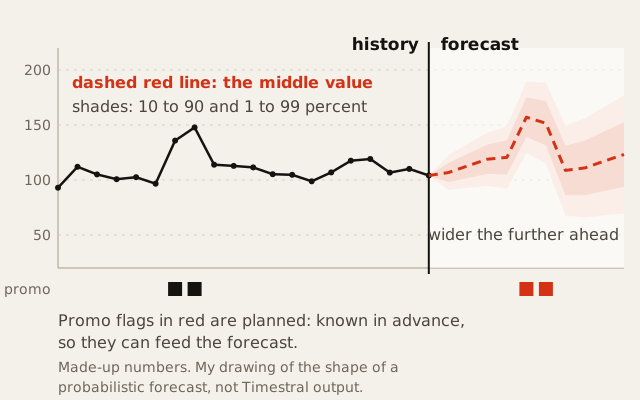
Demand with the promo calendar. The fev-bench paper notes that most pretrained models cannot use covariates, which limits them in retail, where promotion and price data matter for demand forecasts. Timestral takes known-future covariates, so a planned promotion can be an input row.
A range for stock decisions. The upper quantile shows what a strong period could look like. One caution: quantiles for single days do not add up to a quantile for a whole lead time.
A whole catalog. The input also has a series dimension, so one call can forecast many products, each on its own.
Stockouts are not zero demand. The model reads missing values, so I would mark stockout days as missing instead of zero. That is my suggestion, not Mistral’s.
New products. No training on your series is needed, so a product with a short history is worth testing. The post claims scarce data only in general.
Cost. If each forecast took the 140 ms Mistral reported, 10,000 series would take about 23 minutes one after another. That is my arithmetic, not a benchmark.
Made-up numbers, my drawing of a probabilistic forecast, not Timestral output.
By forecasting load, cost and traffic with a range that works as an alert threshold, inside your own infrastructure. This part is my view.
Capacity and cost. Mistral lists observability metrics among enterprise time series, and capacity planning among the decisions they drive.
Alert bands. Compare actual values with the range. If a 1 to 99 percent range is right, about one point in fifty falls outside by chance, so I would require several in a row.
Planned events as inputs. Releases, batch jobs and maintenance windows are known ahead, like the planned shutdowns in Mistral’s example.
Runs where your data is. The weights are small, the code installs with pip, and Forge can deploy on your hardware, air-gapped included. Mistral also sketches pairing it with language models: a forecast flags an anomaly, an agent gathers logs and past incidents.
The license. The monthly revenue limit may rule out the free weights for larger companies.
By turning reporting into expected versus actual: what sessions, signups or revenue should have been, with a range. This part is my view.
Expected versus actual. Forecast sessions, signups or revenue per channel, and review the days outside the range. That fits a dashboard, as in my Claude Dashboards article.
Plans as inputs. Planned spend and send dates are known ahead. The forecast is conditional, not causal: it conditions on your history and does not prove that spend caused a lift.
A drop is not always demand. A forecast can flag a fall but cannot tell lost tracking from lost demand. Check consent and tags first, as in the GA4 and Piwik PRO article.
One definition per series. Meta, GA4 and the store report different revenue, so pick one, as in the three revenues.
Check the license against your company’s monthly revenue.
Pick three series with at least a year of history, and mark gaps as missing, not zero.
Install the package from the repository, which needs Python 3.10 and PyTorch 2.4 or newer, and run the 28M model on a CPU.
Hide the last weeks, forecast them, and compare the error with seasonal naive and with what you use today.
Check the range: an 80 percent band, from the 10th to the 90th percentile, should hold about 80 percent of actual values.
Add the promo calendar as a known-future covariate and see whether the error falls.
Only then try the 209M model, or ask about Forge.
A first run, adapted from the README’s covariate example (I have not run it):
import numpy as np
from timestral import TimestralForecaster
model = TimestralForecaster.from_pretrained("mistralai/Timestral-28M")
# weekly_units: 104 weeks of history, NaN for stockout weeks# promo: 1 for a promo week, 104 weeks of history plus 13 planned weeks
forecast = model.forecast(
weekly_units[None, None, :], # (series, variates, time)
prediction_length=13,
known_covariates=promo[None, None, :], # (series, covariates, time + horizon)
)
low, middle, high = forecast.quantile(0.1), forecast.median, forecast.quantile(0.9)
A few things a retail, tech or marketing team would want to know before it commits.
Results in your field. Mistral gives no e-commerce or marketing results. The fev-bench paper counts 4, 6 and 20 retail datasets in GIFT-Eval, TIME and fev-bench.
Calibration. The post reports no coverage, so I would measure it.
Zeros and hierarchies. It does not discuss products with many zero-sales days, or totals that must add up across products and stores.
The method. The technical report is pending, and the synthetic data is described only in outline.
Access and price. Hugging Face says no inference provider hosts it, and the Forge page lists no price.
What I like is how plain the idea is: give it numbers and calendars, get back a range. That suits e-commerce, where the question is usually how much and how sure. My sample reporting workspace uses made-up numbers and shows the views I would add a range to. It was released on October 15, it is a public preview, and my sources are Mistral’s own pages, so take my enthusiasm for what it is.
Google's Gemini Decisions API, introduced on November 11, 2026, scores a fixed set of answers instead of writing text, in about 200 ms. What it is, what it costs, how Google's lead holds up against Artificial Analysis's own run, how to pair it with an LLM, and where a business could use it.
Mistral Large 4 (Le Chonk) is a model of about 1 trillion parameters whose weights Mistral released on October 29, 2026. What it is, what its license allows, what it costs to use and run, how the top open-weight claim holds up against Artificial Analysis's own runs, and where it could help.
Anthropic's Claude Dashboards and Claude Motion are in beta. What they are, who gets them, how they could change a marketing team for the better (fewer questions waiting for a ticket, numbers that show their query, explainers you can edit) and what to check first.