Mistral Large 4 (Le Chonk) explained: open weights, license, price and what it is good for
Mistral Large 4 (Le Chonk) is a model of about 1 trillion parameters whose weights Mistral released on October 29, 2026. What it is, what its license allows, what it costs to use and run, how the top open-weight claim holds up against Artificial Analysis's own runs, and where it could help.
On October 29, 2026, Mistral released the weights of Mistral Large 4, nicknamed Le Chonk: a model of about 1 trillion parameters that reads text and images and answers in text. Mistral calls it the top open-weight model for coding. The more useful questions are narrower: what is actually open, what does it cost to use, how good is it by independent measures, and where does it fit in an e-commerce, marketing or tech stack. Below: what it is, what the license allows, what it takes to run, how the claims hold up and where I think it could help.
Two disclosures. I have not run Mistral Large 4: this rests on Mistral’s post, its preview post, docs, model cards and license, and the pages of Artificial Analysis and OpenRouter, all read on November 2. And Mistral’s posts never mention e-commerce or marketing, so those parts are my view. As on the rest of this site, the article and its picture were written by an agent, with the tests as the gate.
Mistral Large 4 is a mixture-of-experts model with 1.05 trillion parameters, about 52 billion of them active for each token, that accepts text and images and answers in text. Mistral ran a public preview on its API from October 6 and released the weights on October 29, after three more weeks of reinforcement learning.
Fact
Mistral Large 4, as published
Size
1.05T parameters, 52B active (49B without embeddings), 128 routed experts with 4 active per token
Context
1M tokens
Reasoning
Low, medium or high (the default), set per request
Weights
On Hugging Face: FP8 at 1.06 TB, NVFP4 at 610 GB
License
Mistral Ecosystem Open-Weight License, a modified MIT
API price
$0.70 input, $0.07 cached input and $2.10 output per million tokens
Training
Built from scratch on 3,800 NVIDIA Grace Blackwell GPUs at Mistral’s own datacenters in Europe
Status
Technical report still to come
Mistral’s charts show what the three weeks changed: Terminal-Bench 4.0 went from 28 percent, a self-reported preview figure, to 41, finance spreadsheet work (Finch) from 67.4 to 73.3, and resistance on Lakera’s B3 agent-security test from 93.3 to 97.1 percent.
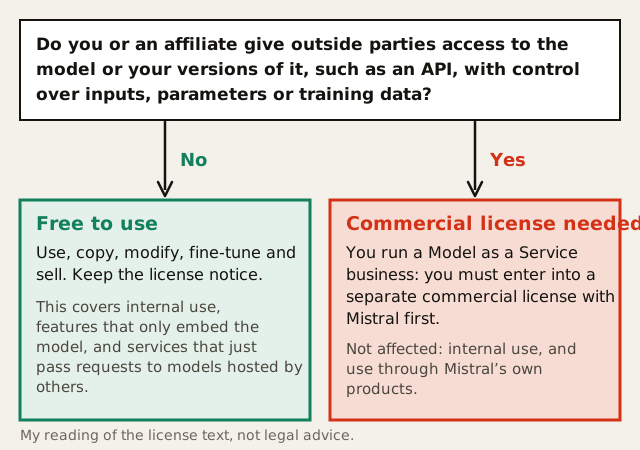
Partly. The weights are free to use, modify, fine-tune and sell, with one condition beyond keeping the notice: a company that runs a model-as-a-service business needs a commercial license from Mistral.
The license is a modified MIT. If you or an affiliate operate a Model as a Service business, you must enter into a separate commercial license with Mistral before using the model or your versions of it commercially. Such a business gives third parties access for inference or post-training, by API or hosted endpoints, say, with “meaningful control over the inputs, parameters, or training data”, the license’s words. Excluded are end-user products that only embed the model in specific features or harnesses, and services that merely pass requests on to models hosted by others. The rule does not apply to internal use, meaning any use that does not make the model or your versions of it available to third parties, or to use through Mistral’s own products. Unlike Timestral’s license, which has a revenue limit, this one has none: see my Timestral article. The model card adds a sentence asking you not to infringe anyone’s rights, and I am not a lawyer, so read the license file.
My reading of the license text, not legal advice.
What does Mistral Large 4 cost, and what does it take to run?#
Through Mistral’s API it costs $0.70 per million input tokens, $0.07 per million cached input tokens and $2.10 per million output tokens. For self-hosting, the weights alone are 1.06 TB in FP8 or 610 GB in NVFP4, before the KV cache.
API. OpenRouter lists the same prices for standard routing, a 1M-token context and up to 256K output tokens. Artificial Analysis calls the prices somewhat above the median for open-weight models of similar size. Mistral’s post also lists Mistral Studio, Microsoft Foundry and NVIDIA-hosted endpoints.
An example, made up. 1,000 product descriptions at 1,500 tokens in and 300 out cost about $1.68 at list price, before reasoning tokens, which count toward the output limit. I would use low effort for simple jobs.
Self-hosting. Mistral states no minimum hardware. Its FP8 recipes use eight-way tensor parallelism, about 130 GB of weights per GPU before the KV cache, which is my arithmetic, so an eight-GPU node of 80 GB cards cannot hold them. The NVFP4 checkpoint targets Blackwell GPUs, with an eight-way vLLM example and a four-way SGLang one.
Serving. vLLM, SGLang, transformers and llama.cpp are listed. An embedded draft head for speculative decoding raises throughput by up to 1.9 times, Mistral says.
How good is Mistral Large 4, and does it earn the top open-weight claim?#
Only in the runs Mistral shows: there it leads two coding tests by 0.4 and 1 points, while Artificial Analysis’s own runs of the same tests put it behind several open models.
Measure
In Mistral’s chart
In Artificial Analysis’s own run
FrontierCode 2.0
19.7 vs 19.3, DeepSeek V4.1 Flash
15.0 vs 28.5, DeepSeek V4.1 Flash 1017
Terminal-Bench 4.0
41 vs 40, GLM-5.3
24.7 vs 41.9, GLM-5.3
AutomationBench
59.9, preview only
57.8 vs 66.6, DeepSeek V4.1 Flash 1017
Cyber Index
51 vs 57, DeepSeek V4.1 Flash
–
Finch, finance spreadsheets
73.3 vs 77.3, Kimi K3
–
BrowseComp, web research
84.5 vs 91.2, Kimi K3
–
Intelligence Index v5
–
26 vs 32, DeepSeek V4.1 Flash 1017 and GLM-5.3
Why the runs differ. Mistral’s two leads come from Cognition’s private run of FrontierCode and from the Coding Agent Index, where the model works inside Mistral’s own Vibe agent. Artificial Analysis uses its own agent harnesses. No page I read explains the gap or says whether its runs are of the preview or the released checkpoint, though its 26 matches the figure Mistral’s model card gives for the release.
Independent aggregate. Artificial Analysis rates the 26 above average among comparable models, whose median is 23. Claude Haiku 5.5 scores 36. Mistral’s model card calls it the highest-scoring Western open-weight model on this index and says the strongest from China score higher.
Independent coding check. Artificial Analysis lists Mistral Vibe with Mistral Large 4 (high) at 48 on its Coding Agent Index, as Mistral says, at $1.26 and 48 minutes per task. Claude Code with Opus 5.5 scores 62 at $11.42, and Codex with GPT-6.1 Sol 54 at $1.50.
Human preference. In blind pairwise code tests with Surge, graders preferred it to GLM-5.3, Kimi K3 and DeepSeek V4.1 Flash in 64, 64 and 56 percent of prompts, and to Claude Opus 5.5 in 22.
Not independent. The other charts are Mistral’s, none carries error bars, and the report is pending.
How could Mistral Large 4 help e-commerce and marketing teams?#
By doing product and campaign work in several languages, from images and spreadsheets, at a moderate price per task and under a license that lets a store run it itself. This part is my view, not Mistral’s.
Product data. The model card lists images, charts and documents as inputs, a 1M-token context, function calling and JSON output that follows a schema. I would test it on turning supplier sheets and photos into feed attributes.
Languages. Mistral claims native fluency in more than 160 languages. The model card’s own list names 39, including Swedish. Test the ones you sell in.
Routine work. AutomationBench-AA, Artificial Analysis’s version of Zapier’s benchmark, has 657 tasks across finance, HR, marketing, operations, sales and support in apps such as Gmail, Google Sheets, Slack, Salesforce and HubSpot. It scores Mistral Large 4 at 57.8 percent, behind DeepSeek V4.1 Flash 1017 at 66.6 and GLM-5.3 at 62.2.
Repeated instructions. Cached input costs a tenth of uncached input, which should suit a long brand guide repeated in every request.
Control. Open weights let you keep customer data in your own infrastructure, and Mistral says it runs a European deployment end to end under European law.
A reality check. A small closed model can score higher overall, so test both on your own jobs, as in my Haiku article.
By giving you a coding agent and a security assistant you can host yourself, at the cost of lower scores than the strongest closed agents and, in Artificial Analysis’s own runs, than several open models. This part is my view.
A self-hostable coding agent. Mistral Vibe is an open-source command-line agent, and the model card shows how to point it at a local vLLM server. The independent score of 48 is below six of the eight agents in its chart, so the draw is control and a cost per task far below Claude Code’s.
Security work. Mistral says it does defensive tasks, such as reproducing and patching vulnerabilities, without needless refusals, and refuses 96.6 percent of malicious cyber requests on three safety test sets. The same post says Mistral sees a potential for uplift in real attacks and is changing its guardrails, and it limits a specialized cyber variant to vetted partners. If you host it, the permissions you give an agent are yours to set, so I would start with read-only access.
Fine-tuning. The model card lists Axolotl, Unsloth and TRL, and Mistral sells customization through Forge.
The license. If you sell hosted access to it, you need a commercial license.
Small, with three jobs you already pay a model for.
Pick three jobs, such as product attributes from supplier sheets, translated descriptions and a code review.
Run 20 real examples of each at low and medium effort through the API and through your current model. Compare quality, JSON validity, latency and cost per job.
Include your smallest language market in the test.
Check the license against your plans: internal use and features that only embed the model are outside the rule, and selling others API access with control over inputs, parameters or training data is inside.
Price self-hosting only if data control needs it: 1.06 TB of FP8 weights or 610 GB of NVFP4, against the API bill.
A few things a team would want to know before it commits.
Minimum hardware. The recipes give example tensor-parallel sizes, not a minimum GPU model or count.
Why the runs differ. The post says the weights lead open models on coding, and Artificial Analysis’s own runs say otherwise. No page says whether the harness explains it, which is my guess.
The language claim. More than 160 in the prose, 39 in the card’s list.
Which checkpoint. Artificial Analysis does not say whether its runs are of the preview or the release.
Status. The docs page still showed a public-preview label and an October 6 date when I read it.
What I like is the combination: open weights with a license that leaves internal use alone, a moderate price per token, and a model card that says plainly where it trails. What I would not do is pick it on the headline, because the independent runs rank it below several open models on coding and agent tasks. The nickname fits: the FP8 weights alone are 1.06 TB, which is a lot of model for most stores, so for most of them the practical question is the API, not the weights. It was released on October 29, the report is pending, and my sources are Mistral’s pages plus Artificial Analysis, so take my enthusiasm for what it is. Mistral’s post names Timestral as part of the same open-weight push.
Google's Gemini Decisions API, introduced on November 11, 2026, scores a fixed set of answers instead of writing text, in about 200 ms. What it is, what it costs, how Google's lead holds up against Artificial Analysis's own run, how to pair it with an LLM, and where a business could use it.
Mistral's Timestral is a family of time-series models that forecast with a range, not one number. What it is, what it does, what its revenue-limited license allows, what I could and could not check in its benchmark claims, and where it could help e-commerce, tech and marketing.
Anthropic's Claude Dashboards and Claude Motion are in beta. What they are, who gets them, how they could change a marketing team for the better (fewer questions waiting for a ticket, numbers that show their query, explainers you can edit) and what to check first.